

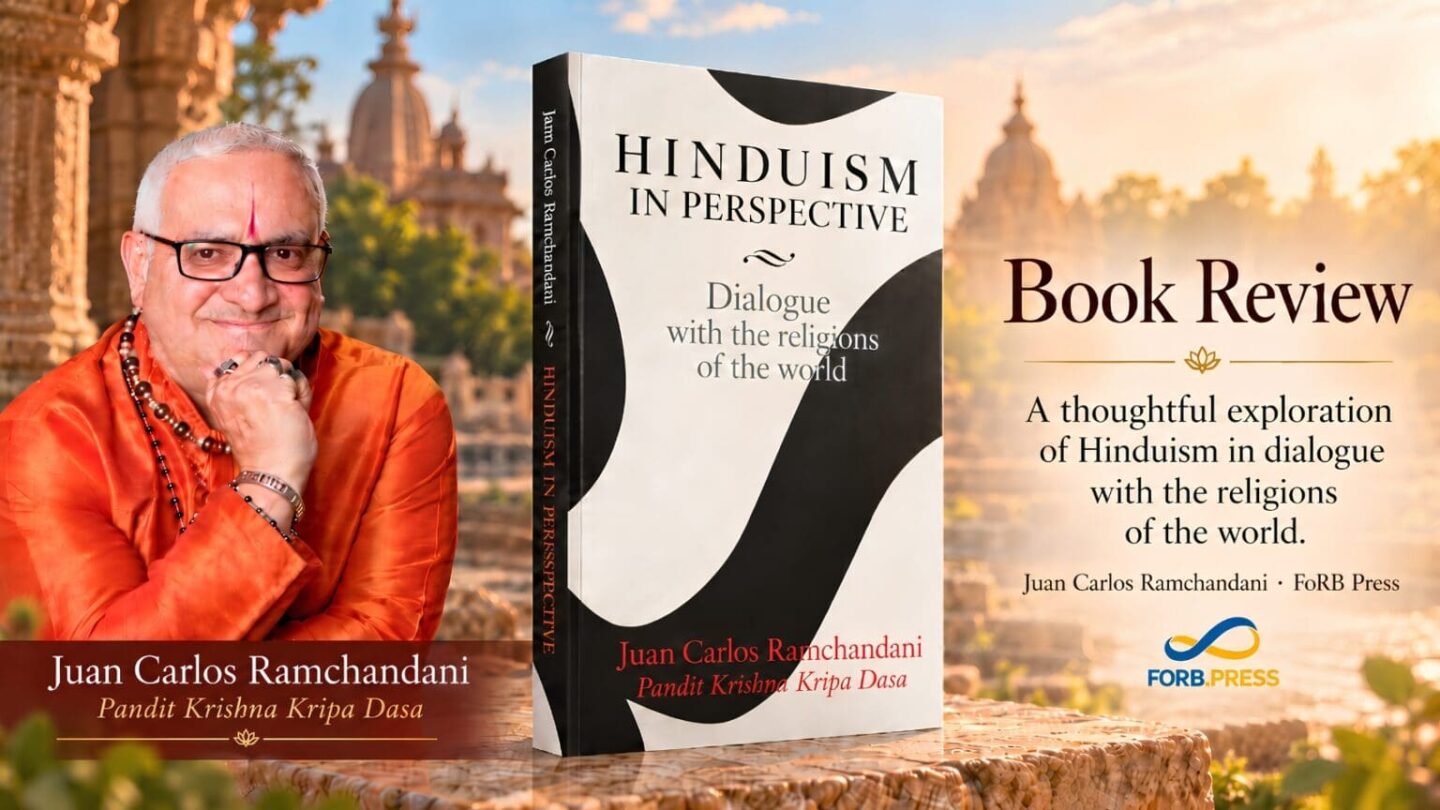
Now available in English and Portuguese, Juan Carlos Ramchandani’s Hinduism in Perspective explores how religious traditions can retain their differences while finding common ground in an increasingly diverse world.
MADRID, October 2026 — What happens when a Hindu priest sits down to examine Christianity, Islam, Buddhism, Judaism and a dozen other religious traditions through the lens of his own faith? For Spanish author Juan Carlos Ramchandani, the answer is neither a contest over religious truth nor an attempt to establish that all religions are fundamentally identical.
Instead, it is an invitation to understand what makes each tradition distinctive — and why those distinctions need not prevent dialogue.
That is the central premise of Hinduism in Perspective: Dialogue with the Religions of the World, a comparative exploration of religion that has just reached a broader international audience with the publication of English and Portuguese editions by FoRB Press.
The book, originally published in Spanish in February 2026, examines Hinduism alongside thirteen religious and philosophical traditions. Its international release follows presentations in several Spanish cities and comes as interest in religious identity, coexistence and cultural diversity remains an important subject of public debate.
A personal history of two religious worlds
The man behind the book has spent much of his life navigating the cultural and religious encounters that he now writes about.
Born in Ceuta, Spain, in 1970, Juan Carlos Ramchandani grew up with an Indian Hindu father and a Spanish Catholic mother. His family background placed him at the intersection of two distinct religious traditions long before interfaith dialogue became a central part of his professional life.
Known by his Hindu name, Pandit Krishna Kripa Dasa, Ramchandani formally embraced Hindu religious practice during his youth, travelled extensively through India and pursued studies in Hindu philosophy, scripture and ritual.
He was ordained as a Hindu priest in 1994 and received the title of pandit in 2000. Since 2015, he has served as president of the Hindu Federation of Spain, participating in national and international initiatives concerning religious freedom, intercultural understanding and dialogue.
His latest book draws on that experience, approaching religious comparison from the perspective of someone who has encountered other religious communities not simply through their sacred texts but through personal relationships.
Thirteen traditions, one starting point
The book begins by explaining the philosophical foundations of Hinduism, also known as Sanatana Dharma.
Readers encounter concepts such as karma, dharma, reincarnation, liberation and the relationship between the individual soul and ultimate reality. The Vedas, Upanishads and Bhagavad Gita provide part of the intellectual background for understanding the tradition’s many forms of spirituality and worship.
From there, Ramchandani moves outward.
He first examines traditions originating in India, including Buddhism, Jainism and Sikhism. The discussion then extends to Confucianism, Taoism and Shinto, before turning to Judaism, Catholic and Protestant Christianity, and Islam.
The final comparisons include the Bahá’í Faith, the Unification Church and Scientology — a choice that broadens the discussion beyond the religions most commonly featured in introductory comparative studies.
Throughout the book, questions about the nature of God, spiritual identity, salvation, reincarnation, religious authority, worship and the role of women help establish where traditions converge and where their differences become particularly significant.
For example, Hindu teachings about the enduring spiritual self stand in contrast to Buddhist teachings concerning the absence of a permanent self. Hindu understandings of reincarnation cannot simply be equated with Christian teachings about resurrection.
Likewise, the use of sacred images in Hindu devotional practice differs substantially from Islamic and Jewish approaches to religious representation.
Rather than avoiding these differences, Ramchandani makes them an important part of the conversation.
Why religious differences matter
An October review in World Religion News highlighted the book’s ability to examine religious similarities without reducing the traditions to interchangeable belief systems.
That distinction is increasingly relevant in societies where religious identities intersect with debates over education, migration, integration, minority rights and freedom of belief.
Comparative religion can sometimes be approached as an exercise in identifying shared ethical principles. While values such as compassion, service and human dignity appear across many traditions, important differences remain in how religious communities understand the Divine, human existence and spiritual fulfilment.
Hinduism in Perspective suggests that meaningful coexistence does not depend on eliminating those differences.
The book also gives attention to the participation of women in religious life, considering how different communities approach female spirituality, religious authority and leadership.
Its broad scope inevitably limits how deeply each tradition can be examined. Readers seeking an exhaustive academic treatment of individual religions will need to look beyond this introductory volume. Nevertheless, the comparative structure offers an accessible starting point for readers unfamiliar with the religious perspectives of others.
From a Spanish publication to an international readership
The new English and Portuguese editions mark a significant expansion for the book.
Published by FoRB Press, an editorial initiative specialising in freedom of religion or belief, the translations bring Ramchandani’s work to audiences beyond the Spanish-speaking world.
The English edition, Hinduism in Perspective: Dialogue with the Religions of the World, and its Portuguese counterpart, O Hinduísmo em perspetiva: Diálogo com as religiões do mundo, were both released in October 2026.
The international expansion is expected to continue.
According to the Spanish newspaper La Verdad de Ceuta, Ramchandani is scheduled to present the Portuguese edition at the University of Coimbra in Portugal on 4 November. An Italian translation is also in preparation.
The original Spanish edition has already been presented in Madrid, Barcelona, Seville, Algeciras, Badajoz and Ceuta.
The English and Portuguese versions include an editorial foreword by FoRB Press director Iván Arjona-Pelado, titled The Courage to Encounter, which addresses the importance of overcoming prejudice through direct contact and genuine understanding.
Its central observation — “Prejudice thrives at a distance” — reflects the broader message running through Ramchandani’s work.
Religion beyond stereotypes
One of the book’s underlying arguments concerns the distance between how religions are commonly portrayed and how their followers actually understand and practise them.
Religious traditions are frequently reduced to headlines, controversies, historical conflicts or a handful of familiar symbols. In that process, their internal diversity and the experiences of ordinary believers can disappear from public view.
Ramchandani’s approach attempts to address this problem through explanation rather than argument.
His comparative chapters provide readers with an opportunity to consider religious traditions from the perspective of a Hindu practitioner who acknowledges both their common concerns and their distinctive theological frameworks.
The approach also raises a question relevant far beyond religion: can individuals and communities maintain strong identities while remaining genuinely curious about those who see the world differently?
For Ramchandani, the answer appears to lie in the distinction between understanding and agreement.
Learning what another person believes does not require adopting that belief. Equally, disagreement does not have to become hostility.
A book for an increasingly connected world
With its publication in three languages and a fourth translation under development, Hinduism in Perspective enters an international publishing landscape in which readers increasingly encounter cultures, philosophies and religious traditions far removed from those of their upbringing.
The book does not claim to settle centuries of theological debate. Nor does it propose a universal religious formula capable of reconciling every contradiction.
Its ambition is more practical: to give readers enough understanding of different beliefs to make informed, respectful encounters possible.
For students of religion, educators, interfaith practitioners and general readers interested in the spiritual traditions of the world, it offers an accessible introduction to comparative religious thought from a distinctly Hindu perspective.
And at a time when religious identities can become sources of social division, its essential proposition is worth considering: understanding another faith need not weaken one’s own.
Sometimes, the most meaningful dialogue begins precisely where agreement ends.
Book information
- Title: Hinduism in Perspective: Dialogue with the Religions of the World
- Author: Juan Carlos Ramchandani (Pandit Krishna Kripa Dasa)
- Publisher: FoRB Press
- English and Portuguese editions: October 2026
- English paperback ISBN: 978-84-12-44716-3
- Formats: Paperback and eBook
- Availability: Amazon, Kindle and Google Play Books
Further reading: World Religion News review | Publisher’s book page