

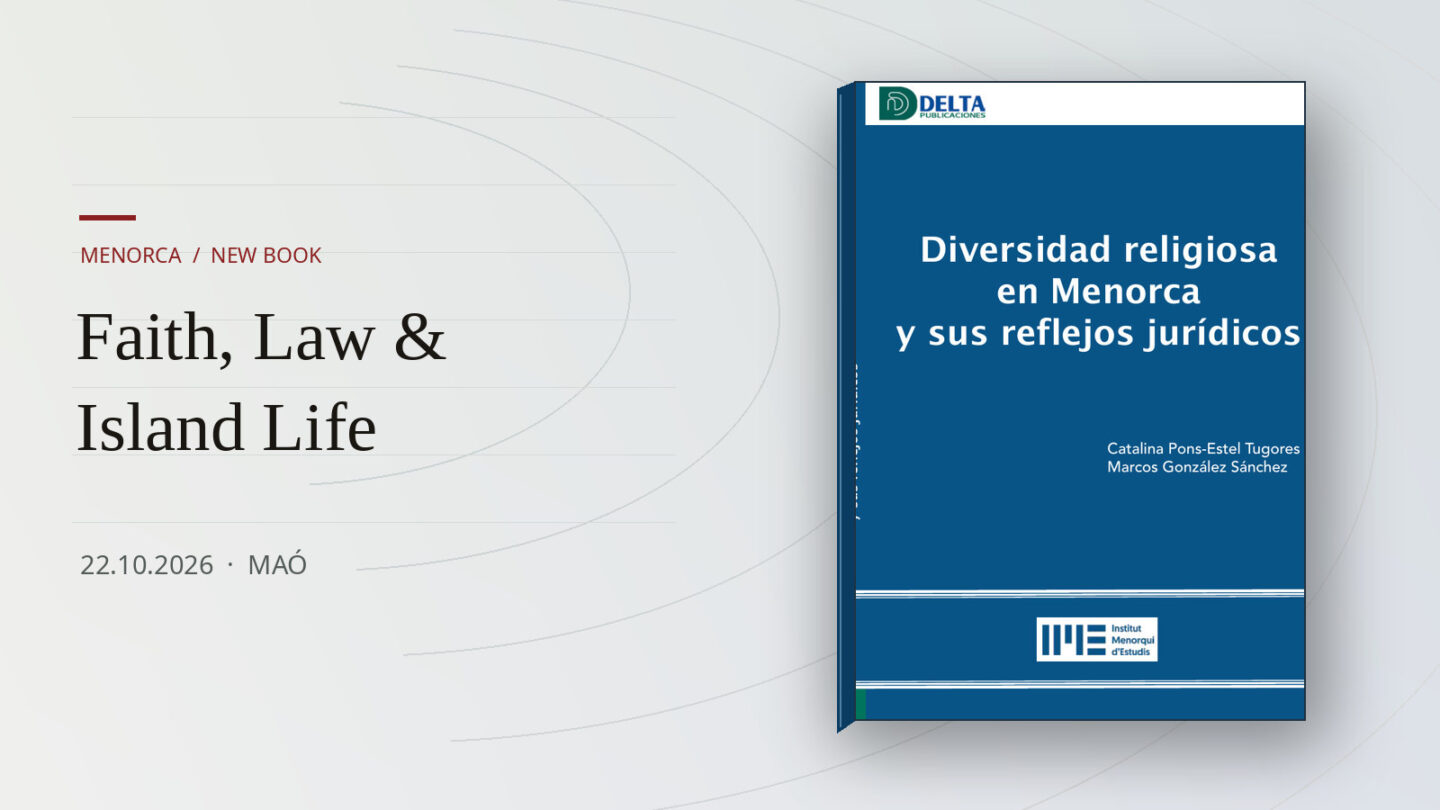
MAÓ, Menorca — An island’s religious past is visible in its architecture and festivals. Its religious present can be less obvious: it takes shape in classrooms, places of worship, public services and decisions made by local authorities. A forthcoming book about Menorca invites readers to look at this other side of the island’s cultural life.
Diversidad religiosa en Menorca y sus reflejos jurídicos (Religious Diversity in Menorca and Its Legal Implications) will be presented at the Institut Menorquí d’Estudis in Maó on 22 October. Written by legal scholars Catalina Pons-Estel Tugores and Marcos González Sánchez, it considers religious plurality not only as a matter of identity or history, but as something that intersects with everyday civic arrangements.
The other map of Menorca
The outline of the book suggests an unusually practical range. Alongside questions about the recognition of religious communities, it considers education and religious instruction, social assistance, religious services, media, places of worship, cemeteries, cultural heritage and local festivities. It also addresses relations with regional and municipal administrations.
Read together, these subjects form a different kind of island map. A cemetery or a festival may be part of a place’s inherited landscape; a school or municipal office must also respond to the people who live there now. What rules govern those encounters, and how are different convictions treated? Those are the sorts of questions a study of the law’s relationship with religion can bring into focus.
It would be premature, however, to describe the authors’ conclusions as if the book had already been publicly discussed. The announced presentation is intended to introduce the research findings. The interest at this stage lies in the project’s scope and in its choice to examine these questions through one specific community rather than through national statistics alone.
A local research project with a wider readership
The publication grew out of La diversidad religiosa en Menorca, a project supported by a research award from the Institut Menorquí d’Estudis’ 2023 programme.
Pons-Estel Tugores is a civil-law academic at the University of the Balearic Islands and leads the research project. González Sánchez teaches state ecclesiastical law at the Autonomous University of Madrid. Their collaboration predates this volume: in 2019 they jointly coordinated an issue of the academic journal Derecho y Religión dedicated to Spain’s autonomous communities and religious freedom.
Both have also received Fundación Mejora’s Religious Freedom Award for their previous work: González Sánchez in 2019 and Pons-Estel Tugores in 2020. The distinction adds context to their academic interests, but the new book stands on the questions posed by its Menorcan subject matter.
A book launch open to the island
For a reader interested in local history or contemporary society, the publication offers a reminder that cultural life does not stop at monuments and traditions. It also includes the ways people organise their communities and the decisions that shape participation in shared spaces. The book’s contribution can be assessed more fully once its findings are presented.
The authors will introduce the volume and discuss their research at 6:30 p.m. on Thursday, 22 October 2026, at the Institut Menorquí d’Estudis, Camí des Castell, 28, Maó. Admission is open to the public. Further information about the host institution is available on the IME website.