

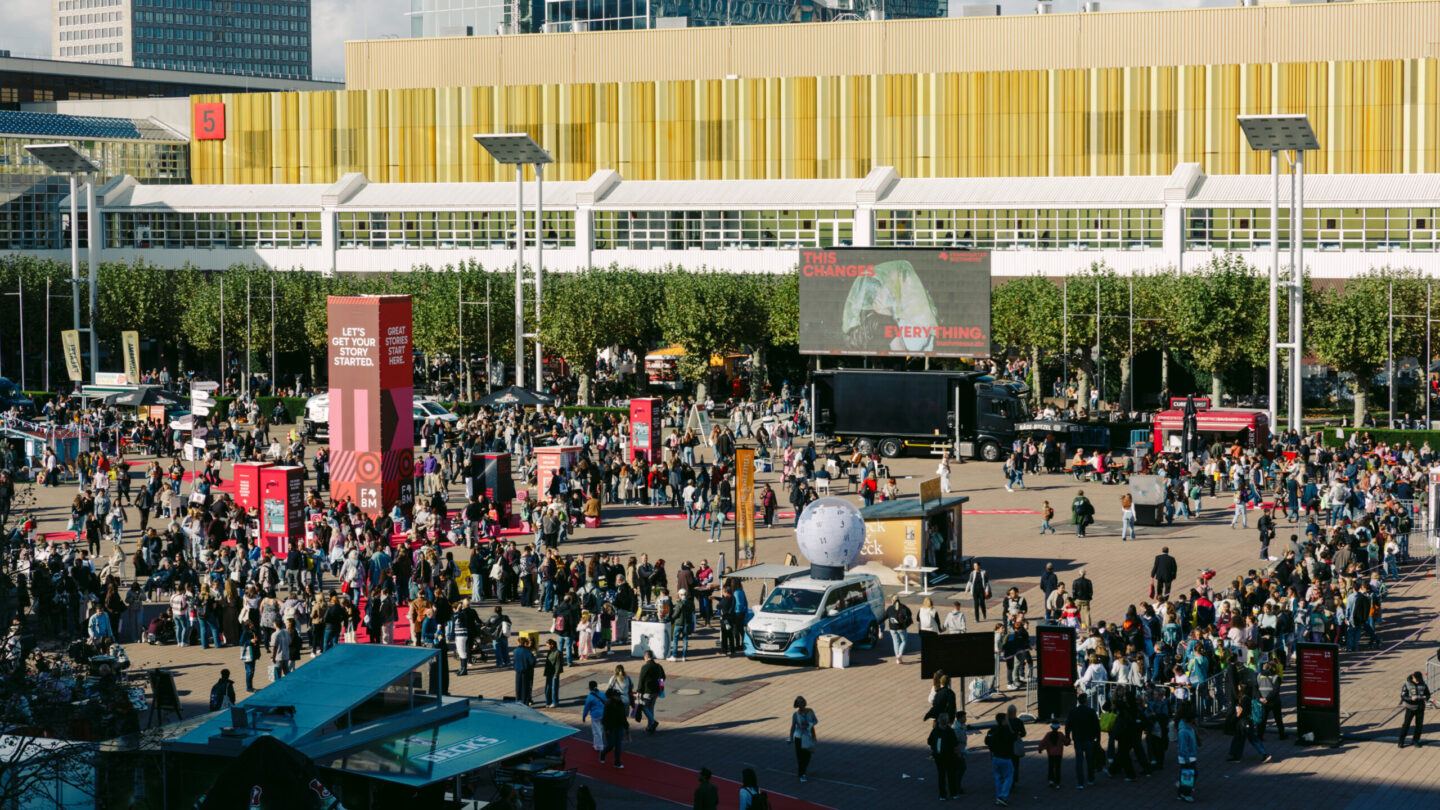
FRANKFURT, Germany — The Frankfurt Book Fair closed its 2026 edition with 236,000 visitors from 137 countries, as publishers, authors, agents and readers gathered for five days of business, debate and literary events at a time of rapid technological change across the publishing industry.
The 78th Frankfurter Buchmesse, held from 7 to 11 October, attracted 119,000 professional visitors and 117,000 members of the public, according to figures released by organisers. Around 4,000 exhibitors participated, while more than 3,800 events were held both at the exhibition grounds and across Frankfurt.
Attendance remained at roughly the high level recorded the previous year, while trade professionals arrived from a broader range of countries. Organisers said representatives from several countries not recorded among professional visitors in 2025 attended this year’s edition, reinforcing Frankfurt’s role as one of the publishing industry’s most international marketplaces.
Publishing business behind the crowds
While the weekend brought thousands of readers into halls devoted to books, authors, manga, fantasy, romance and audio, much of Frankfurt’s significance continued to lie away from the public stages.
Publishers and literary agents used the fair to negotiate translation, territorial, audiobook and screen rights, meet distributors and develop international partnerships.
The Literary Agents & Scouts Centre hosted 319 agencies from 32 countries, while it and the Publishers Rights Centre together sold hundreds of meeting tables for scheduled negotiations.
The 2026 edition also introduced a reorganised hall structure intended to create a clearer distinction between areas centred on professional business and those designed primarily for the general public.
That reflects a broader evolution of Frankfurt itself. What was once overwhelmingly a trade fair has increasingly become two events operating simultaneously: a global publishing marketplace and a large-scale cultural festival.
Artificial intelligence moves to centre stage
Few issues generated as much discussion this year as artificial intelligence.
Publishers are increasingly exploring AI for translation, editorial assistance, production, marketing and data analysis. At the same time, writers, publishers and rights specialists are debating more difficult questions concerning the material used to train generative systems, copyright, consent and compensation.
The tensions are particularly significant for an industry whose commercial model depends heavily on intellectual property.
Sebastian Guggolz, chairman of the German Publishers and Booksellers Association, identified artificial intelligence and declining reading skills among younger generations among the major challenges facing publishing.
Yet the scale of public attendance in Frankfurt also offered evidence that books and literary culture continue to command substantial interest despite competition from streaming, social media and other forms of digital entertainment.
Audiobooks expand beyond traditional markets
Audio publishing emerged as another major area of growth.
Frankfurt Audio attracted an expanded presence, while companies used the fair to outline international plans for audiobooks and spoken-word content.
Spotify said its audiobook service was expected to expand from 22 markets to more than 180 by the end of 2026, while Audible presented international research examining changing listening habits.
The debate was not limited to English and other major publishing languages. Participants also explored how audio could help smaller linguistic communities distribute stories and cultural material without depending entirely on conventional print publishing.
That potential nevertheless raises familiar publishing questions: who controls distribution, how works are discovered on large platforms and how revenues are divided between creators, publishers and technology companies.
Books increasingly travel to screens
Frankfurt also highlighted the increasingly porous boundary between publishing, film and television.
The fair’s Book-to-Screen programme brought literary agents and publishers together with producers and directors seeking stories for adaptation.
Among the projects discussed was the adaptation of Jenny Erpenbeck’s Visitation, while the forthcoming Netflix adaptation of Melanie Raabe’s The Trap illustrated the continuing appetite among streaming platforms for literary properties.
For publishers, screen rights can turn a successful book into an international property and introduce authors to entirely new audiences. For producers, the publishing industry remains a vast source of already-developed stories and characters.
Czechia takes the cultural spotlight
Czechia, the 2026 Guest of Honour, used the fair to present a wide-ranging programme under the theme “A Country on the Coast.”
The deliberately paradoxical image of a coastline for landlocked Czechia became the organising idea behind a 2,300-square-metre pavilion featuring readings, installations, performances and professional events.
More than 75 Czech authors participated in over 100 events, while organisers said more than 100 Czech books had been published in German translation since preparations for the Guest of Honour programme began in 2024.
Established writers including Radka Denemarková, Jáchym Topol and Kateřina Tučková appeared alongside a younger generation of Czech authors.
At the conclusion of the fair, Czechia formally passed the Guest of Honour role to Chile, which will take centre stage at Frankfurt in 2027.
Literature, politics and freedom of expression
The programme extended well beyond the commercial concerns of publishing.
The Frankfurt Calling initiative staged 125 events across 14 locations, bringing writers, lawyers, academics and public figures into discussions on democracy, international law, surveillance and freedom of expression.
Among those participating were historian Jill Lepore, lawyer and author Philippe Sands and United Nations communications chief Melissa Fleming.
Sands received the 2026 Peace Prize of the German Book Trade at Frankfurt’s Paulskirche on the final day of the fair.
The International Publishers Association also presented its first Freedom of Expression Defenders Award to the Media Coalition in the United States.
These programmes underlined a longstanding dimension of Frankfurt: the fair is not only a place where books are sold, but also one where arguments over who can publish, who can speak and who controls access to information regularly enter the international spotlight.
Decades-long relationships remain important
Even as the publishing industry discusses AI and increasingly digital forms of distribution, Frankfurt continues to depend heavily on long-established professional relationships.
Among exhibitors marking a milestone this year was New Era Publications International, which celebrated 45 years of participation at the Frankfurt Book Fair with an anniversary reception on 8 October.
The Denmark-based publisher, which publishes fiction and nonfiction works by L. Ron Hubbard, was one example of the many publishing houses for which Frankfurt has become an annual meeting point across several generations of industry change.
Such anniversaries illustrate a central feature of the fair that is sometimes obscured by attendance figures and headline events: much of the publishing business still depends on relationships built through repeated personal contact among editors, publishers, agents, translators and distributors.
A book fair negotiating the future of books
Frankfurt 2026 ultimately presented an industry living simultaneously in several eras.
Traditional print publishing remains at the heart of the fair. Rights negotiations and translation continue much as they have for decades. Readers still queue to meet authors and discover new books.
But surrounding that familiar world is a rapidly expanding ecosystem of audiobooks, streaming adaptations, creator platforms and artificial intelligence.
The challenge for publishers will be to take advantage of those technologies without undermining the intellectual property and creative labour on which their industry depends.
For five days in Frankfurt, those competing pressures occupied the same halls.
And with 236,000 people attending, the continuing attraction of the world’s largest publishing gathering suggests that, whatever form books take next, the international conversation surrounding them remains very much alive.
The 79th Frankfurt Book Fair is scheduled for 6–10 October 2027, with Chile as Guest of Honour.